
Social Security Insolvency Needs “Attention, Not Panic” - finance.yahoo.com

It seems every day we see a new report on Social Security’s rapid descent toward financial insolvency, with many recent articles reinforcing the probability of a 2032 full depletion date for the trust funds. The projections for benefit cuts that would accompany the mandatory shift to cash-in/cash-out also seem to be accelerating, with the most recent estimate set at 28%. No wonder seniors are rattled.
In the face of all this, retirement expert Chris Orestis, president of Retirement Genius, suggests the situation deserves attention, not panic. He goes on to explain why the alarm bells can be silenced, or at least dulled, for now, in a post on finance.yahoo.com that you can read in full here.
For those new to the problem or who need a quick refresher on Social Security’s plight, we offer this analysis, excerpted from a previous post on this site.
Defining the Problem
When the trust fund reserves are fully depleted, Social Security benefits will be forced to move to a cash basis, where benefits paid must equal revenues received. The reality of this situation sets program beneficiaries up for severe consequences in about seven years. As noted earlier, this is projected to result in a substantial across-the-board cut in benefits that will grow as more retirees enter the program.
This is not the first time insolvency has surfaced in the program’s history. With the remedial action taken in the early 1980s, it was projected that the trust fund would remain solvent for 75 years; unfortunately, changing demographics have rendered this projection obsolete, with the point of full cash reserve depletion now projected to be reached some 25 years sooner.
A Quick Recap of How We Got Here
Depletion of Social Security’s trust fund cash reserves can be attributed to several key factors, beginning with the length of time benefits need to be paid to beneficiaries. For example, since 1940 life expectancy for those reaching age 65 has grown substantially, increasing by 9.7% for females and 8.5% for males, a trend expected to continue increasing through the end of the century.
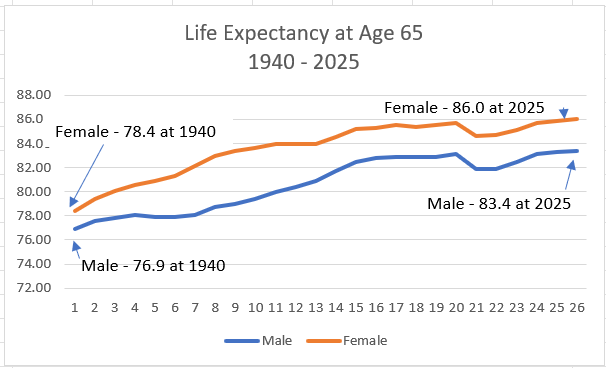
Source – https://www.ssa.gov/OACT/tr/2025/V_A_demo.html#226697
The fact that American seniors are living longer is indeed a positive societal development, but it presents a challenge to ensuring long-term Social Security solvency. In addition to longer life expectancy, the “Baby Boomer” generation has been reaching retirement eligibility since 2008. This population cohort is unusually large—76 million—and is expected to nearly double the number of Americans over age 65 by 2031.[1] With many baby boomers claiming benefits early and many of them leaving the workforce entirely, it is expected that there will be additional pressure on Social Security’s cash flow as the number of beneficiaries grows faster than the number of workers contributing to the program. On this point, the taxpayer-to-beneficiary ratio has dropped dramatically, skidding from 42:1 in 1945 to less than 3:1 today, with projections indicating a continued decline in the years ahead.[2] Further, the most recent annual Social Security Trustees’ report noted, “There were about 2.7 workers for every OASDI beneficiary in 2024.”[3]
Another factor relates to the size of the future taxpaying workforce. The CDC reports that the 2020 U.S. birthrate fell by 4% from 2019 and, after a slight uptick in 2021, again dropped in 2022 and 2023, marking a return to a pattern of declining births. This tends to presage the expected decline in the taxpayer-to-beneficiary ratio,[4] as does the 3% increase in the U.S. infant mortality rate reported by the National Center for Health Statistics in 2023. [5] As a result, Social Security is projected to see a continuing decline in the number of taxpayers, exacerbating the program’s current and future deficit projections[6].
In addition to the above drivers, Steven C. Goss, Social Security’s former Chief Actuary, has cited an even more significant factor in the projected depletion of the trust fund. Specifically, Goss suggested that the phenomenon of “earnings dispersion” has created a situation in which an unexpectedly large share of earnings is escaping payroll taxation because an increasing number of higher earners exceed the annual taxable maximum. He reports results of a study showing that the ratio of total payroll to taxable earnings has dropped from a projected 90% to 82.5%, with real wage growth for the top 6% of earners outstripping that of the lower 94% by 45%. The effect on projected Social Security finances is dramatic, with 7.5% of a total payroll of roughly $15 trillion essentially escaping the 12.4% payroll tax. Goss further projects that the lower taxable ratio will continue in the years ahead, further aggravating Social Security’s financial situation. Full coverage of Goss’s remarks can be viewed here.
Will the Problem be Fixed?
Despite the potential for catastrophe, Congress can restore Social Security Solvency if lawmakers act swiftly, much like they did with the 1983 Amendments. It is imperative that corrective action be undertaken as far in advance of the full depletion of the trust fund as possible to minimize disruption. While immediate action is critical, so too is adopting the best long-term solution.
The Social Security Administration has evaluated hundreds of proposals in recent years, and a steady stream of ideas has emerged to modify the program for the 21st-century economy. It’s anybody’s guess on the timeline for congressional action, but most analysts understand that this is not a self-correcting problem, and action is needed sooner rather than later.