
Latest News
An Interesting Perspective on the Projection of Social Security’s Trust Fund Depletion
Projections are just that…an estimate of what research has concluded will happen over a prescribed horizon. In the case of Social Security’s steadily eroding financial picture, the 2026 Trustees Report projects the Old-Age and Survivors Insurance (OASI) trust fund will be fully depleted in the fourth quarter of 2032, and the combined trust funds (OASI and Disability Insurance, or OASDI) in the third quarter of 2034.
Many folks tend to view actuarial projections as simple guesses about what might happen, knowing that what actually happens is subject to unknowns and wide swings in assumptions. Given the potential for scoffing at 2032 as the point at which the OASI reserves reach zero, it might be good for any naysayers to take a look at the Social Security Trustees’ consistent projection record as shown here:
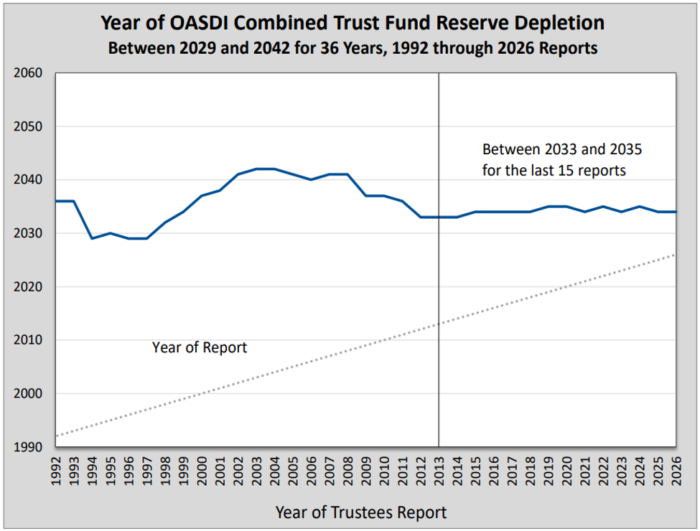
This chart, copied from Social Security Chief Actuary Karen Glenn’s June 12 briefing on the 2026 Trustees Report, shows that over the past 34 years, the annual depletion projections have been remarkably consistent. In fact, from 2013 through this year’s report, the OASDI full depletion projection has not wavered out of the 2033-2035 range.
The main point to take from this is that the current insolvency projections rest on a solid statistical foundation and are very real. Time is, in fact, running out, and Congress needs to act sooner rather than later. As Ms. Glenn noted in her briefing remarks, “we are basically at the point where we are at later. There’s not much sooner left.” You can review the full June 12 briefing, which features Ms. Glenn’s analysis of the 2026 Trustees Report and remarks from AEI’s Mark J. Warshawsky and Andrew G. Biggs here. For anyone wanting to better understand the state of Social Security’s finances, watching this one-hour briefing would be time well spent.
This posting is presented for informational purposes only and does not represent legal or financial guidance. Any opinions or interpretations presented are either those of the original author or, in the case of articles authored by the AMAC Foundation, are the opinions of AMAC Foundation staff, originally trained and accredited by the National Social Security Association (NSSA) and certified via the AMAC Foundation. Any links included in the article are valid on the posted date; socialsecurityreport.org cannot guarantee the duration of the links’ validity. NSSA and the AMAC Foundation and its staff are not affiliated with or endorsed by the Social Security Administration or any other governmental entity. To submit a question, visit our website (https://amacfoundation.org/services/) or email us at ssadvisor@amacfoundation.org. Because we are a non-profit organization, there is no charge for these services.